


If you’ve ever stood next to a C Frame crank press during a stamping, bending, or punching job, you’ve probably seen those long, smooth metal bars running along the sides of the ram—those are the guide rails, and they’re way more important than they look at first glance. As someone who’s been supplying C Frame presses for years, I can’t tell you how many first-time buyers ask me, “Why do these things even matter? The crank does the work, right?” Let me break this down, because skipping over guide rails is like trying to bake a cake and forgetting the flour—you might get away with it once, but it’ll fall apart every single time after that.
First, let’s quickly ground ourselves: a C Frame crank press works by turning a flywheel (powered by a motor) to spin a crankshaft, which pushes the ram straight down to apply force to whatever you’re working on. The “C Frame” part is the open, horseshoe-shaped frame that lets you load large parts or feed material from the side, which is why so many metal fabricators love these machines. If you’re in the market for one, you might have looked at options like a C-Frame Deep Throat Press (great for reaching deep into parts) or a C-Frame Single Crank Press for smaller, high-speed runs. Even the bigger jobs use C-Frame Double Crank Press models, which need solid guide rails even more because they’re pushing way heavier loads.
Now, back to those guide rails. Their main job is simple on paper: keep the ram moving in a straight, vertical line up and down. But in the real world, that’s a way bigger task than it sounds. Let’s say you’re stamping a 10-gauge steel bracket—if the ram tilts even a tiny bit when it pushes down, the hole you punch will be off-center, or the bend will have an uneven edge. That’s not just a cosmetic issue; it’s a scrap rate killer, and scrap costs shops thousands of dollars a year. The guide rails stop that tilt. They’re precision-machined so the distance between them is consistent, and they fit snugly against bushings on the ram—no play, no wobble.
Wait, but why not just use the C Frame itself to guide the ram? Good question. The frame is strong, but it’s not perfectly rigid. When you apply 50 tons of force to a small area (like a punch or die), the frame will flex a little—even high-quality frames. The guide rails act as a second, fixed point that cancels out that flex. Think of it like this: if you try to push a pencil straight down with your finger, it might bend or slip to the side. But if you hold the pencil between two rulers as you push, it goes exactly where you want it. That’s exactly what guide rails do for the ram.
Another big job: absorbing side loads. Here’s a secret a lot of new press operators don’t know—no press applies force perfectly straight 100% of the time. When you’re punching a hole off-center, or bending a part that’s slightly misaligned, the ram will push sideways a little, not just down. If the guide rails weren’t there, that side force would go straight into the crankshaft, the bearings, and the frame. Over time, that would wear those parts out fast—you’d be replacing bearings every few months instead of every few years, and that’s a huge downtime hit. The guide rails take that side load and distribute it evenly across their length, so the rest of the press doesn’t get beat up.
Let me give you an example from a shop I work with. A few years back, they bought a cheap C Frame mechanical press (you can check out our line at C-Frame Mechanical Press) that skimped on the guide rails. The rails were thin, poorly machined, and had too much clearance. Within six months, their punch accuracy was off by 0.02 inches—enough that 15% of their parts were scrap. They tried adjusting the dies, replacing the crank bearings, nothing worked. Finally, they upgraded to a press with properly designed guide rails, and the scrap rate dropped to less than 1%. That’s the kind of difference this part makes.
Now, not all guide rails are created equal. You’ll see two main types on C Frame crank presses: full-length rails and partial rails. Full-length rails run almost the entire height of the ram’s travel. They’re better because they have more surface area to distribute force, and they prevent tilting even when the ram is all the way up or all the way down. Partial rails are shorter, usually for smaller presses with lower tonnage, but they’re not ideal for heavy-duty jobs. If you’re running 100+ ton presses, full-length guide rails are non-negotiable.
Another thing that matters is the material and finish of the rails. Most good presses use hardened steel for the rails, because it resists wear from the ram’s bushings. The finish has to be super smooth—like, mirror-smooth, actually—because any rough spots will wear out the bushings faster and cause the ram to bind. Cheaper presses will use mild steel or skip the hardening, and within a year, the rails are scored, the ram wobbles, and you’re back to scrap parts. Guide rail maintenance is pretty simple, too—lubricate them regularly with the right oil or grease, check for wear every few months. I always tell customers to make guide rail inspection part of their weekly maintenance checklist; it’s way cheaper to replace a set of bushings or a few rails than to fix a broken crankshaft.
Wait, let’s talk about the performance side too. For high-speed operations—like stamping 50 parts a minute for automotive parts—guide rails have to be extra precise. If the ram moves even a tenth of a millimeter off-line at that speed, it can damage the die, which costs thousands to replace and shuts down production. The guide rails ensure that the ram is consistent cycle after cycle, so your dies last longer and your production runs are smooth. That consistency translates to better part quality, faster runs, and less downtime—all of which mean more profit for your shop.
I’ve also seen how guide rails impact operator safety. A ram that tilts is more likely to misalign with the die, and if that happens, a piece of material can fly up or out. Proper guide rails keep the ram moving as intended, reducing the chance of accidents. For shops that run lights-out operations (no operators on the floor during runs), the guide rails’ consistency is even more important—there’s no one there to catch a misaligned ram if something goes wrong.
Let me address a common misconception: some people think that because crank presses are “simple” machines, guide rails aren’t a big deal. But the opposite is true. Crank presses rely on the ram’s motion being exact because the force is applied in a single, straight line. If you compare a hydraulic press, which has a cylinder that keeps the ram aligned, a crank press needs the guide rails to do that job. No guide rails, no alignment, no reliable performance.
So, what should you look for when evaluating a C Frame crank press? Don’t just check the tonnage or the stroke length—take a close look at the guide rails. Are they full-length? What material are they made of? How’s the machining finish? A good supplier will show you close-ups of the rails, explain how they distribute load, and tell you what kind of maintenance they need. At our company, we make sure every press we sell has precision-machined, hardened steel guide rails, because we’ve seen firsthand how that small part can make or break a customer’s success.
If you’re in the market for a C Frame crank press, whether it’s a deep throat model for large parts, a single crank for high-speed runs, or a double crank for heavy tonnage, the guide rails are one of the most critical components to inspect. Skipping over this part to save a few bucks on a cheap press will cost you way more in scrap, downtime, and repairs down the line. We’re here to help you pick the right press for your needs, and we can walk you through every part, including the guide rails, so you know exactly what you’re getting.
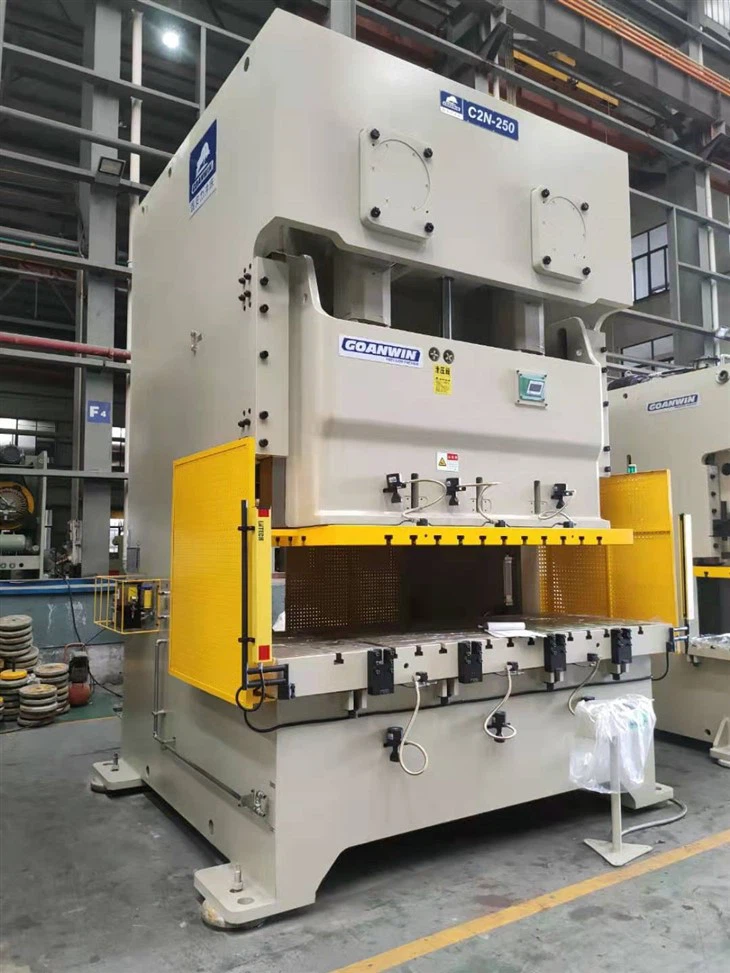

If you’re ready to chat about your stamping, bending, or punching needs, or want to learn more about our C Frame press line, reach out to us—we’d love to help you find the perfect solution for your shop. Don’t let an afterthought like guide rails derail your operations; get the right machine from the start, and you’ll be running smooth for years.
References:
- American Society of Mechanical Engineers. (2019). Design and Operation of Mechanical Presses. ASME Press.
- Metal Stamping Association. (2021). Key Components of C-Frame Presses and Their Impact on Production Quality. MSA Technical Bulletin.
- Crane, F. A. A. (2020). Fundamentals of Press Machinery Maintenance. Industrial Press Inc.


