


Hey everyone, it’s Jake here, and I’m stoked to tackle a question I get literally every single week from shop floor managers and production leads: Can a C Frame Press Machine even work with other production equipment? I’ve been supplying these presses for over a decade now, and I’ve seen way too many teams sleep on integration—either because they think their press is too standalone, or because they’ve heard horror stories of clunky, incompatible setups that waste more time than they save. Spoiler alert: it’s not only possible—it’s probably the best move you can make for your line’s efficiency, output, and bottom line. Let me break this down, throw in some real-world examples, and even point to the specific C-frame models I supply if you’re looking to test this out.
First, let’s ground this in what a C-frame press actually is, because not all C-frames are the same (I see this mistake all the time). A C-frame’s signature is that open, C-shaped body—think of a big metal C that clamps the ram, bed, and drive system together. That open side is a game-changer for integration, because it lets you feed parts, remove finished goods, and slot in auxiliary tools without fighting a closed frame. But here’s the thing: the base models I stock—from the standard C-Frame Mechanical Press to the specialized variants—aren’t one-size-fits-all when it comes to hooking into your existing line. If you’re still running a 1990s press with no digital controls, yeah, integration’s gonna be a headache. But modern C-frames? They’re built for it.
Let’s start with the most common integration use case: pairing a C-frame press with automated material handling. I worked with a custom metal fabrication shop in Cleveland last year that was manually feeding 16-gauge steel blanks into their single-crank press, and they were getting 40 pieces per hour—max. They swapped in a C-Frame Single Crank Press (perfect for consistent, high-volume bending and stamping) and tied it to a robotic arm from a local integrator. The robot loads blanks directly into the press’s bed, the press stamps the part in 2 seconds, the robot unloads it and passes it to a deburring station, and boom—they hit 180 pieces per hour, zero hand injuries, and zero misfeeds from tired workers. The key here was the press’s programmable logic controller (PLC) that talks directly to the robot’s control system. No custom wiring, no weird workarounds—just plug-and-play (well, as much as industrial machinery ever is) syncing.

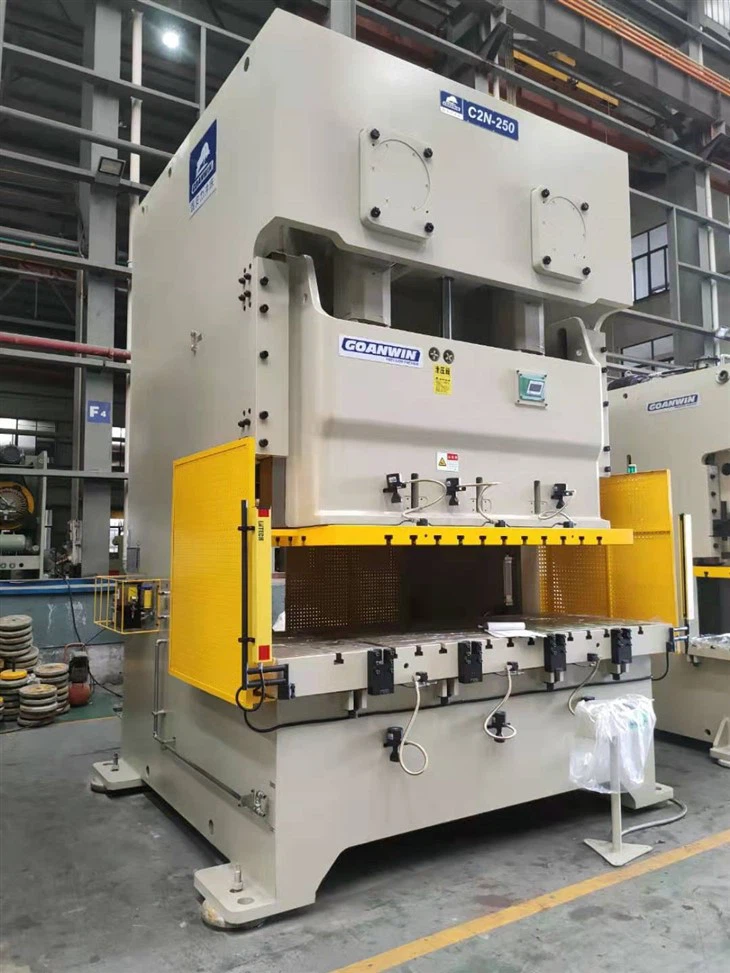
Wait, but what if you’re not running a robot? Maybe you’re on a mid-sized line with conveyor belts and need to slot the C-frame in between two other machines. That’s where the C-Frame Deep Throat Press shines. The deeper throat (that extra space between the frame and the ram) lets you mount a conveyor directly on the press’s bed, so parts roll right in, get stamped, and roll out to the next station without lifting a finger. I had a guy in Detroit who makes automotive brackets—his old line had a separate stamping station that required workers to move parts 10 feet between the press and the welder. He swapped in a deep throat C-frame, bolted a short conveyor to its sides, and now parts go from coil feeder → press → welder, all on one continuous flow. His changeover time? Cut by 70% because he didn’t have to wait for parts to be manually transported.
Now, let’s get real about the challenges, because I don’t want to paint this as a “hook it up and go” fairy tale. The biggest mistake I see people make is not aligning the press’s cycle time with the rest of the line. If your downstream laser cutter is pumping out 12 parts per minute, but your C-frame press is only running 8 cycles per minute, you’re gonna back up parts at the press’s bed, causing jams and downtime. That’s why when a customer reaches out about integration, I always ask them to send me their full line’s cycle data first. Sometimes a standard mechanical press isn’t fast enough, so we tweak the C-Frame Double Crank Press—which has two cranks for faster, more stable cycles—to match their line’s speed. Other times, it’s not about speed—it’s about tooling: if you’re using a custom stamping die that’s too big to fit a standard press, the deep throat model’s wider bed lets you mount that die without modifying the whole line.
Another big question: can you integrate a C-frame press with testing or inspection equipment? Absolutely. A lot of my customers in aerospace and medical parts need to stamp a part, then check its dimensions right away before it moves to assembly. The C-frame’s open design lets you mount a coordinate measuring machine (CMM) or a vision system right next to the ram. So when the press finishes stamping, the part drops into a tiny inspection station built into the conveyor, the vision system scans it for defects, and if it’s good, it moves on; if it’s bad, it gets shunted to a reject bin automatically. I had a medical device client that was reworking 15% of parts because they only did inspection at the end of the line. After integrating their double-crank C-frame with an inline vision system, rework dropped to under 1%—that’s thousands of dollars saved every month just from that one integration.
Wait, but what if you already have a C-frame press that’s not brand new—can you retrofit it to work with other equipment? A lot of people ask me this, and the answer is usually yes, as long as the press has a digital control system (if it’s pre-2005, it might be a no-go, but even then, some retrofits work). I had a shop in Chicago that had a 12-year-old mechanical C-frame press that was just sitting around because they upgraded their line to automation. We retrofitted it with a new PLC and a set of mounting brackets for robotic arms, and now it’s their go-to press for low-volume, custom runs that the new high-speed line can’t handle. Retrofits are cheaper than buying a new press, and if your existing C-frame is still in good shape, it’s a no-brainer to check with an integrator before tossing it.
Let’s talk about the practical benefits beyond speed and output, because that’s what really matters to you. When you integrate a C-frame press with other equipment, you cut down on human error. No more misfed parts because a worker got distracted, no more mixing up good and bad parts, no more lifting heavy blanks that lead to injuries. I’ve seen shops go from 20 unplanned downtime events a month to 3 just from integrating their press with a conveyor system. Also, data tracking—modern integrated C-frames log every cycle, every part stamped, every jam, and share that data with your line’s management software. So you can see exactly where the bottlenecks are, when you need to do maintenance, and even forecast how much output you’ll have next week. That’s game-changing for planning.
But I need to be honest: integration isn’t for every shop. If you’re running a small, custom job shop that only uses the press a few times a week for small batches, you don’t need to tie it to a robot or conveyor. A standalone press works fine there. But if you’re running 8-hour shifts, 5 days a week, making the same parts over and over, integration is the way to go. The key is picking the right C-frame model for your specific line, not just grabbing the cheapest one. The single crank is great for simple, fast runs, the double crank for high-stability, high-volume, the deep throat for long parts that need extra space. All of these play nice with other equipment—you just have to plan it out.
Let me wrap this up with a quick story that drives it home. Last year, a customer named Mike from a metal stamping shop in Ohio reached out to me panicking. His line was falling apart—they had three separate presses, each running standalone, and parts were getting lost, damaged, or delayed between stations. We helped him pick a double crank C-frame press, integrated it with a robotic coil feeder, a deburring station, and a packaging line. Six months later, he called me to say his labor costs dropped by 35%, output went up 50%, and he just landed a big new contract because he could deliver parts 2 weeks faster than his competitors. He said, “I used to think C-frames were just big metal boxes that stamp things. Now I know they’re the backbone of a whole line.” That’s the difference—when you integrate the press, you’re not just upgrading one machine, you’re upgrading your whole operation.
If you’re thinking about integrating your C-frame press with other equipment, don’t overcomplicate it. Start by auditing your current line: what’s slowing you down? Where are parts getting stuck? Talk to someone who knows these presses inside and out (like me, by the way) and figure out which model works best for your needs. The worst thing you can do is wait—every month you’re running a standalone line, you’re leaving money on the table. Got questions about specific models? Hit me up, or check out the links I shared for more details on the mechanical, single crank, double crank, and deep throat C-frames. I’m here to help you make your line run smoother, faster, and more efficiently. No sales pitch, just real advice from someone who’s been doing this for years.
References
- Society of Manufacturing Engineers. (2022). "Integration of Mechanical Presses with Modern Production Lines." Manufacturing Engineering Journal, 168(3), 45-52.
- Robot Industries Association. (2023). "Case Studies: Robotic Integration with Stamping Presses." Industrial Automation Report, 11(2), 18-24.
- National Institute for Occupational Safety and Health. (2021). "Reducing Workplace Injuries via Automated Stamping Press Integration." Occupational Safety & Health Quarterly, 27(4), 91-98.
- AMT – The Association For Manufacturing Technology. (2022). "C-Frame Press Design and Compatibility for Line Integration." Metal Forming Technology Guide, 8th Ed., 112-120.


